

14 Mar The foundations of dog training, part 1 – Reward and timing
If you do not have something your dog wants, training becomes impossible. If you reward your dog at the wrong moment, the dog learns the wrong thing. Reward and timing therefore form the foundation of training. Their importance and role are present every single time you train a dog.
Reward, also known as a reinforcer
When training through positive reinforcement, meaning rewarding the dog, learning happens faster and the results tend to be more lasting. The purpose of the reward is to strengthen a behavior. This is known as positive reinforcement “R+”.
A reinforcer is whatever the dog finds meaningful at that moment and what it wants the most in that specific situation. A human cannot decide this on the dog’s behalf. The only way to discover what the dog values at any given moment is by observing both the dog and the training situation.
Often the first thing worth checking during training is whether the reward you are using is appropriate for that particular moment. When you learn to understand what your dog values in different situations, you are already very far along in your training skills.
If your dog wants what you have, it will work with more enthusiasm and motivation. At the same time, you become highly meaningful to the dog. You become the gate to the things the dog wants.
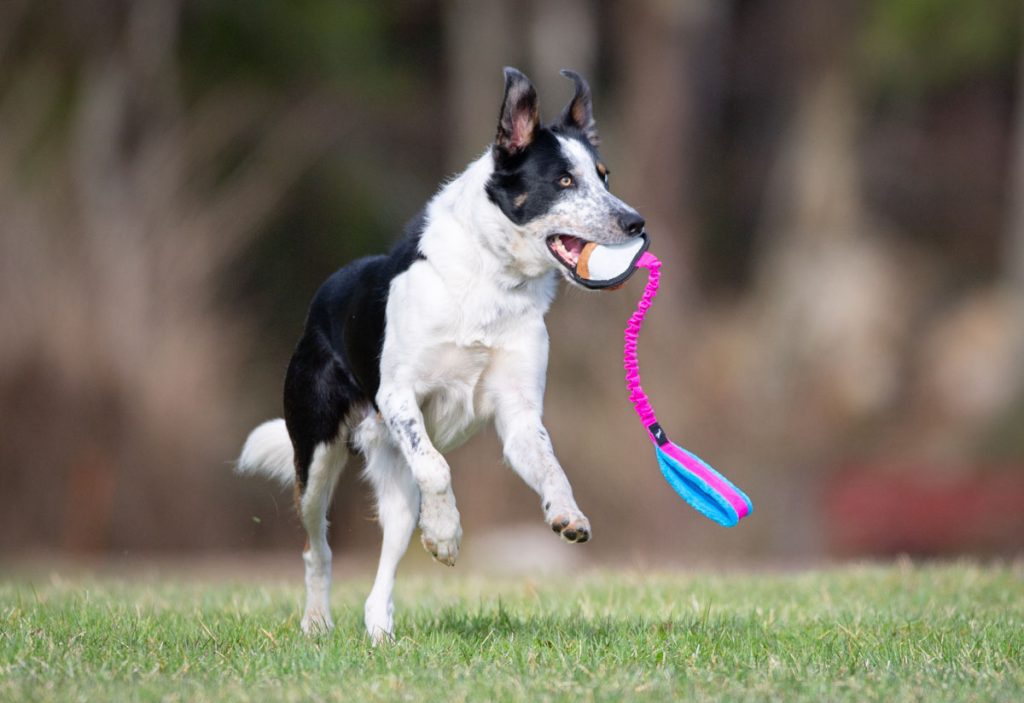
Often the toy itself is not the reward. The real reward is playing with it.
Removing the possibility of reward
When training with positive reinforcement, punishment is not used. At most, the opportunity for reward is removed. This simply means the dog does not receive the reward if it does not perform the desired behavior.
For example, if you move the food bowl behind your back when the dog jumps, you are removing the possibility of reward. Almost every trainer uses this technique in some form. In its simplest form, stopping when the leash tightens is also removing a reward. The dog cannot move forward, which is what it wanted in that situation.
However, a truly skilled trainer often does not even need these techniques.
In many situations, attention itself becomes a very effective reward for the dog. Even a verbal correction or an emotional reaction from the human can reinforce behavior. If you remove that reaction and therefore the reward, the behavior often fades quickly. And if you are able to reward the correct behavior instead, you can justifiably congratulate yourself.
The most challenging situations are those where the behavior itself is rewarding for the dog. In these cases the dog already receives reinforcement from the action. Usually these behaviors are species or breed typical actions such as barking or chasing.
In these situations prevention is often the best strategy. For example, if a dog guards the window and barks at neighbors, closing the curtains prevents the behavior from being reinforced.
Treats as rewards
Food rewards are easy and quick to use. One common challenge is that trainers tend to rely on the same treats again and again. It is important to constantly vary the selection.
Ideally you should keep searching for new and better rewards throughout your dog’s life. Training becomes much easier when you are not stuck using only one or two familiar treats. The better the reward, the easier it is to achieve results.
Sometimes eating the reward becomes a quick mechanical swallow for the dog. Food rewards gain much more meaning when the dog receives enthusiastic praise at the same time. You can happily talk to your dog while it eats the treat. Over time the dog learns that praise itself also has value.
When choosing a reward you should always consider how it affects the dog.
Challenges when using food rewards
For small dogs the size of the treat matters a great deal. The quality of the reward should also be considered, because if you use many treats you must reduce the amount of regular food.
If the treat is valuable enough, even a tiny piece may be sufficient for a larger dog. One meatball can easily be cut into twenty small rewards.
Lickable treats can also be very convenient. Paste can be squeezed from a tube in small portions, or you can use a roll on dispenser similar to a deodorant bottle. The bottle can be filled with something like meat broth. Both types are available in pet stores.
Some dogs are extremely enthusiastic about food and become overly excited when they see treats. For some dogs hunger reduces concentration, while for others it provides just the right amount of motivation. If your dog is highly food motivated, make sure it is not too hungry before training.
An overly exciting reward can also interfere with concentration. When choosing a reward you should always consider how it affects the dog.
For example, when teaching a dog to remain still, energetic play may not be the best reward. Instead a chewable treat might work better. A lively dog may calm down if the reward requires chewing or if several treats are scattered on the ground. As the dog searches and eats, it often settles down slightly.

Play influences the whole dog
If you have played with your dog since puppyhood, using play as a reward becomes easy. However, play can also be taught to adult dogs. Most dogs can become excited about some kind of game with their human.
The key is to find the type of play that the individual dog enjoys. Often the toy alone is not the reward. Playing with the toy is what matters most.
Play can raise arousal, build confidence, and motivate the dog to perform. At the same time it is important to observe how play affects the dog’s learning.
Too much arousal weakens learning. Very intense play can overwhelm a sensitive dog. Play should always be tailored to the situation and the individual dog. It is also important to teach cues for starting and ending the game.
Precise timing requires speed
The reinforcer should follow the desired behavior within less than a second. The more precise the timing, the faster the dog learns.
Timing problems are extremely common and often cause frustration. The dog simply does not understand which behavior earns the reward.
Good timing requires speed, which is why clicker training was developed. With a clicker the reward can be marked at the exact moment the dog performs the correct behavior.
In simple terms, clicker training means conditioning the dog to a reward marker. The dog learns that a specific sound, such as a click, predicts a reward. This association is created by repeating the click and immediately delivering a reward dozens of times.
Once the dog understands the marker, training can begin. The sound marks the exact moment of the correct behavior, and the reward follows immediately.
Dogs can also learn several reward markers. Different markers can be used for play, toys or even petting.
The more precise the timing, the faster the dog learns.
Your dog notices the moment your hand moves toward the treat pouch
Always pay attention to when the reward becomes visible, especially if you are not using a reward marker.
For example, if you try to lure a stopped dog to move forward by taking a treat from your pocket, the dog may indeed move. However the problem is that the reward appeared when the dog was standing still. The dog therefore associates the reward with stopping.
If the trainer’s hand moves before the reward marker, the dog interprets that movement as the signal for reward. The behavior that becomes reinforced is whatever the dog was doing at the moment the hand moved, not necessarily the behavior that was later marked.
Dogs observe and react extremely quickly, which means trainers must be aware of their own physical movements.
The importance of mechanical skills
If the dog performs another action after the reward marker but before receiving the reward, that action may also be reinforced. This is why a trainer’s mechanical skills are so important.
You must act quickly, but only after the marker signal has been given. Fast and impatient dogs in particular may perform several behaviors before the reward reaches their mouth.
The time between the marker and the delivery of the reward should be as short as possible. However nothing should happen before the marker signal.
Mechanical skills are very easy to practice. While watching a soccer match, you can mark each moment the ball is passed and drop a treat into a bowl in front of you. You can even film yourself doing this and later evaluate your timing.
Pay particular attention to whether your hand moved only after the marker signal. Video recording is an excellent tool for evaluating training. Watching your own actions improves your training skills enormously. Video reveals both successes and mistakes with complete honesty.
Original author Piia Collan, 27 April 2022
Author Piia Collan
Piia Collan is a professional dog trainer based in Vääksy, Finland, working with dogs and their people at every stage of life. She helps build strong everyday skills, balanced training routines and a deeper cooperation between dogs and handlers — from puppies to adult and senior dogs. Piia’s approach is tailored to each dog and family, grounded in modern, dog-friendly training methods that support both learning and overall well-being. Her services are available locally, across Finland and internationally through online training and lectures. She offers private coaching, home visits, phone consultations, live online seminars and training courses. In addition, Piia provides exclusive in-home dog care, where dogs become part of her daily life during their stay. She also works closely with breeders and canine organizations, supporting responsible training and lifelong dog welfare.
Latest articles & product guides
- Joy of Dog Sports training toys: which dog training toy is right for your dog?
 Choosing the right training toy can make a surprisingly big difference to how much your dog enjoys playing and how useful the toy is in training. But with different shapes, sizes, fillings and designs available, how do you know which dog training toy is the…
 - Dog stress and recovery
 Dogs tolerate stress differently depending on factors such as their genetics and personality, age and stage of development, intended purpose, health and previous experiences. Stress cannot be avoided completely and there is no reason to fear mild stress. Most dogs cope well even with intense…
 - When your dog turns out not to be easy
 Not every dog is easy. Not every story can be neatly put back together. Not every kind of difficulty fits under the same heading. There are the ordinary challenges of everyday life that almost every dog owner encounters. And then there are situations that begin…
 - The teenage dog phase
 Adolescence is a long developmental stage that begins when the sensitive socialization period ends and puppyhood comes to a close. Some dogs mature well before the age of two, while for others the process takes significantly longer. This long teenage phase can be filled with…
 - ProPack bag family comparison – Which dog sports bag is right for you?
 ProPack bag family comparison – Which dog sports bag is right for you? When you spend long days training dogs, travelling to competitions or balancing everyday life with active dogs, having the right dog sports bag makes a huge difference. A well-designed dog training bag…
No Comments