

12 May The pitfalls of puppy life and how to avoid them
Even though puppy owners often fear making mistakes, very few things in puppy life actually fall apart because of one or even several individual mistakes. Problems usually arise because, with the best intentions, people try to do too much, too quickly and in too many directions at the same time. Many things become easier once, instead of trying to fix individual problems, you begin looking at where the overload in everyday life is really coming from.
When good everyday life turns into constant performance
Dog owners often have a huge number of thoughts and expectations long before the puppy has properly settled into its new home. What should be taught first, how much socialisation is needed, how much activity the puppy requires, how to build a good everyday routine and what absolutely needs to be done immediately in the beginning. Behind all of this is usually a genuine desire to do things as well as possible. People fear ending up with a “problem dog”, while forgetting that such a thing does not really exist. There are only dogs and problems.
Connected to this fear is one of the most common pitfalls of puppy life. When you want to succeed, it becomes very easy to collect together a huge number of things that all seem important. Everyday life starts filling up with exercises and different goals that are no longer based on actual daily needs. Individual things may be good and justified on their own, but the overall picture may no longer support the puppy or the owner in the best possible way.
The challenges of puppy life are rarely caused by someone doing something clearly wrong. Much more often, the issue is that everyday life turns into constant performance. There is too much happening in each day. Both the puppy and the owner get too little rest, experiences accumulate faster than the puppy is able to process them and expectations quietly rise higher than what the puppy is truly capable of handling at that stage. Puppyhood disappears behind expectations that are simply too high.
People fear ending up with a “problem dog”, while forgetting that such a thing does not really exist. There are only dogs and problems.
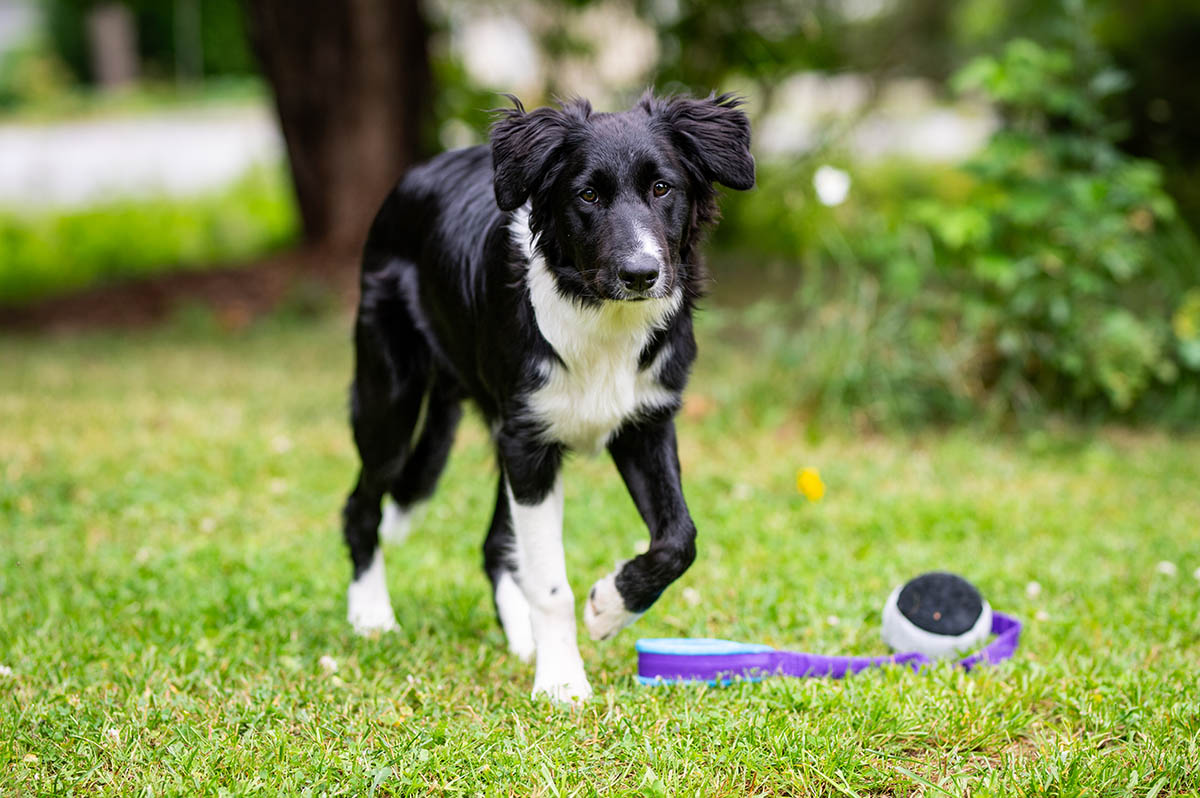
People fear ending up with a “problem dog”, while forgetting that such a thing does not really exist. There are only dogs and problems.
When exhaustion looks like hyperactivity
There are many things in puppy life that may seem small on the surface, yet still create a surprising amount of stress and overload. One new place, a visit somewhere, a badly slept night, staying awake slightly too long, a difficult encounter or just a few consecutive days where the rhythm of daily life does not settle properly. None of these things alone are necessarily major issues, but together they quickly begin affecting how well the puppy can cope with everyday life.
Challenges in puppyhood should not only be viewed through individual situations. If all the attention stays focused on the fact that the puppy gets overexcited and bites everything in the evenings, the focus easily shifts only to the symptom itself. Instead of treating the symptom alone, it is often much more important to understand how the puppy’s everyday life as a whole is affecting it. Otherwise, attention remains stuck on what is visible instead of what the behaviour is actually communicating. Sometimes the explanation is very simple: an overexcited puppy simply needs sleep. Once it gets enough rest, it no longer chews trouser legs or bounces endlessly around people’s feet. You might even be able to train it properly afterwards.
Many energetic puppies are interpreted as dogs that simply need more activity and stimulation. In reality, the underlying issue is often exhaustion, which does not appear as calmness, but as increased arousal and frantic behaviour. In those situations, adding even more activity does not solve the problem. It deepens it.
A small puppy does not always know how to stop on its own, even when its body and nervous system already desperately need rest. It needs help from the owner. Rest is not a break from learning. It is a requirement for learning. When rest increases, behaviour often becomes calmer without needing to change much else at all.
Puppy life does not need to become an amusement park
One of the most common pitfalls is trying to offer the puppy as much as possible immediately from the beginning. People actively socialise the puppy, practise skills, introduce different environments and constantly invent activities so the puppy would get the “best possible start” in life. The idea itself is understandable and good, but the overall amount of stimulation easily becomes overwhelming for the puppy, even when everything is technically pleasant and positive. The puppy ends up living in a constant flood of stimuli.
A puppy does not constantly need more things to do. It needs an appropriate amount of experiences and enough time to process them. Every puppy is an individual and that individuality must be taken into account. Puppies are learning all the time, even when nothing special is happening. Because of this, the biggest improvements do not always come from adding more activities into daily life. Often they come from improving the quality of what is already being done and considering whether those activities are truly suitable for that particular puppy.
In puppyhood, more does not automatically mean better. Even boredom is a skill that puppies need opportunities to learn. If everyday life starts revolving around constantly inventing something new for the puppy to do, the direction is often already wrong. Nobody wants to spend days and days in an amusement park without a break.
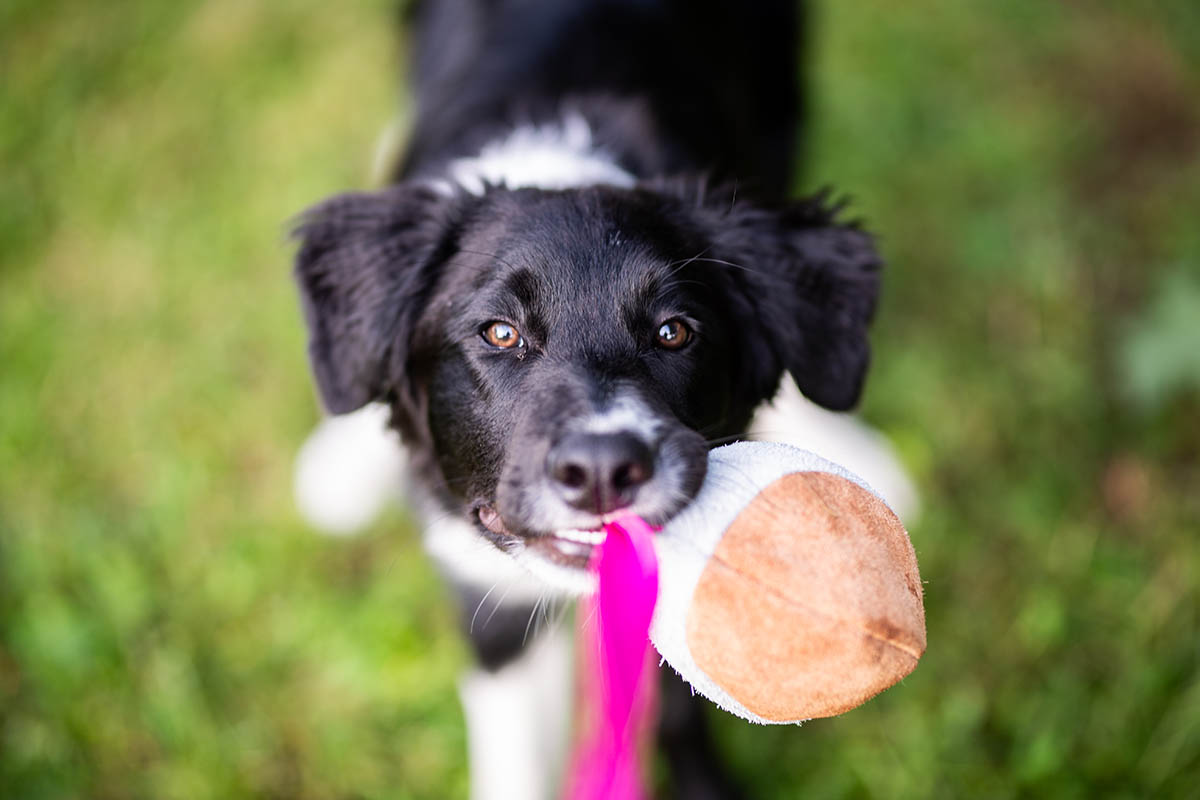
A puppy does not constantly need more things to do. It needs an appropriate amount of experiences and enough time to process them.
In socialisation quality matters more than quantity
Socialisation is one of the most important things during puppyhood, but it is also surrounded by many misunderstandings. It is often viewed as a checklist of things that must all be experienced before the socialisation period ends. As a result, attention easily shifts toward what has already been “completed” instead of focusing on how those experiences actually felt for the puppy.
The socialisation period is short and has enormous significance for the dog’s future. That is why the crucial thing is not how many experiences can be squeezed in, but whether the experiences are appropriate and manageable for the puppy. One calm and successful experience builds far more than several situations that are too difficult.
Socialisation is not about taking the puppy everywhere as quickly as possible. It is about allowing the puppy to explore the world in a way it is actually capable of processing. No experience builds confidence if it is too overwhelming for the puppy.
People’s attention easily becomes focused on visible behaviour that is interpreted as a problem. The underlying need behind that behaviour may then go unnoticed, even though understanding it would often help the situation the most.
A puppy is not a project, but a dog
A puppy cannot be viewed only through the lens of training. It is an animal with innate needs that guide its behaviour every single day. Sniffing, chewing, movement and social interaction are not extra activities. They are the foundation of wellbeing.
If these needs are not sufficiently fulfilled, the dog begins searching for ways to fulfil them independently. Behaviour then easily starts looking problematic, even though the dog is simply trying to cope with the situation using its own methods. At that point, the first question should not be what needs to be forbidden, but what needs to be made possible.
People’s attention easily becomes focused on visible behaviour that is interpreted as a problem. The underlying need behind that behaviour may then go unnoticed, even though understanding it would often help the situation the most.
A puppy does not know yet and it does not need to
A puppy is not a miniature adult dog and it cannot yet behave consistently from one situation to another. It is constantly learning, and learning requires time, repetition and an environment where success is possible. Still, everyday life often includes expectations that the puppy is not ready for yet. A confident or bold puppy also does not necessarily mean a fully capable puppy. Sometimes it simply means a puppy trying to cope with a situation that is still too big for it.
When expectations become too high, everyday life starts feeling heavy for both the dog and the owner. When expectations are adjusted to match the puppy’s age and stage of development, many things become easier without needing to actively “fix” anything at all. Realistic thinking does not slow down progress. It makes progress possible. Neither the owner nor the puppy should be expected to be perfect.
Puppies learn the most through everyday life
Individual training sessions are only a small part of the whole picture. Most learning happens in ordinary daily situations that people do not always even recognise as training. Puppies constantly observe humans and learn from them how to react to the world, what different situations mean and what everyday life looks like.
Dogs do not only learn from formal puppy classes. They learn from the way people live with them every day. That is why clarity, consistency and predictability in everyday life are often far more important than individual techniques or exercises.
When everyday life supports the puppy well enough, many things begin building naturally on top of that foundation.
Why less if often more
The pitfalls of puppy life are rarely single dramatic mistakes. More often, they are small and understandable things that begin repeating in everyday life and slowly accumulate into overload. Too much activity, too little rest, rushing socialisation, overlooking needs and unrealistic expectations are all extremely common and deeply human mistakes. That is exactly why they are so widespread.
When everyday life is clear enough and the puppy gets what it truly needs, many things begin working without needing separate correction. Very often, the biggest change does not happen because you do more. It happens because you understand what can be left out and what this individual puppy actually needs more support with in its daily life.
In the end, the most common pitfall of all is simply expecting too much from yourself and your puppy far too early.
Original author Piia Collan, 12 May 2026
Author Piia Collan
Piia Collan is a professional dog trainer based in Vääksy, Finland, working with dogs and their people at every stage of life. She helps build strong everyday skills, balanced training routines and a deeper cooperation between dogs and handlers — from puppies to adult and senior dogs. Piia’s approach is tailored to each dog and family, grounded in modern, dog-friendly training methods that support both learning and overall well-being. Her services are available locally, across Finland and internationally through online training and lectures. She offers private coaching, home visits, phone consultations, live online seminars and training courses. In addition, Piia provides exclusive in-home dog care, where dogs become part of her daily life during their stay. She also works closely with breeders and canine organizations, supporting responsible training and lifelong dog welfare.
Latest articles & product guides
- Dog stress and recovery
 Dogs tolerate stress differently depending on factors such as their genetics and personality, age and stage of development, intended purpose, health and previous experiences. Stress cannot be avoided completely and there is no reason to fear mild stress. Most dogs cope well even with intense…
 - When your dog turns out not to be easy
 Not every dog is easy. Not every story can be neatly put back together. Not every kind of difficulty fits under the same heading. There are the ordinary challenges of everyday life that almost every dog owner encounters. And then there are situations that begin…
 - The teenage dog phase
 Adolescence is a long developmental stage that begins when the sensitive socialization period ends and puppyhood comes to a close. Some dogs mature well before the age of two, while for others the process takes significantly longer. This long teenage phase can be filled with…
 - ProPack bag family comparison – Which dog sports bag is right for you?
 ProPack bag family comparison – Which dog sports bag is right for you? When you spend long days training dogs, travelling to competitions or balancing everyday life with active dogs, having the right dog sports bag makes a huge difference. A well-designed dog training bag…
 - The pitfalls of puppy life and how to avoid them
 Even though puppy owners often fear making mistakes, very few things in puppy life actually fall apart because of one or even several individual mistakes. Problems usually arise because, with the best intentions, people try to do too much, too quickly and in too many…
No Comments