

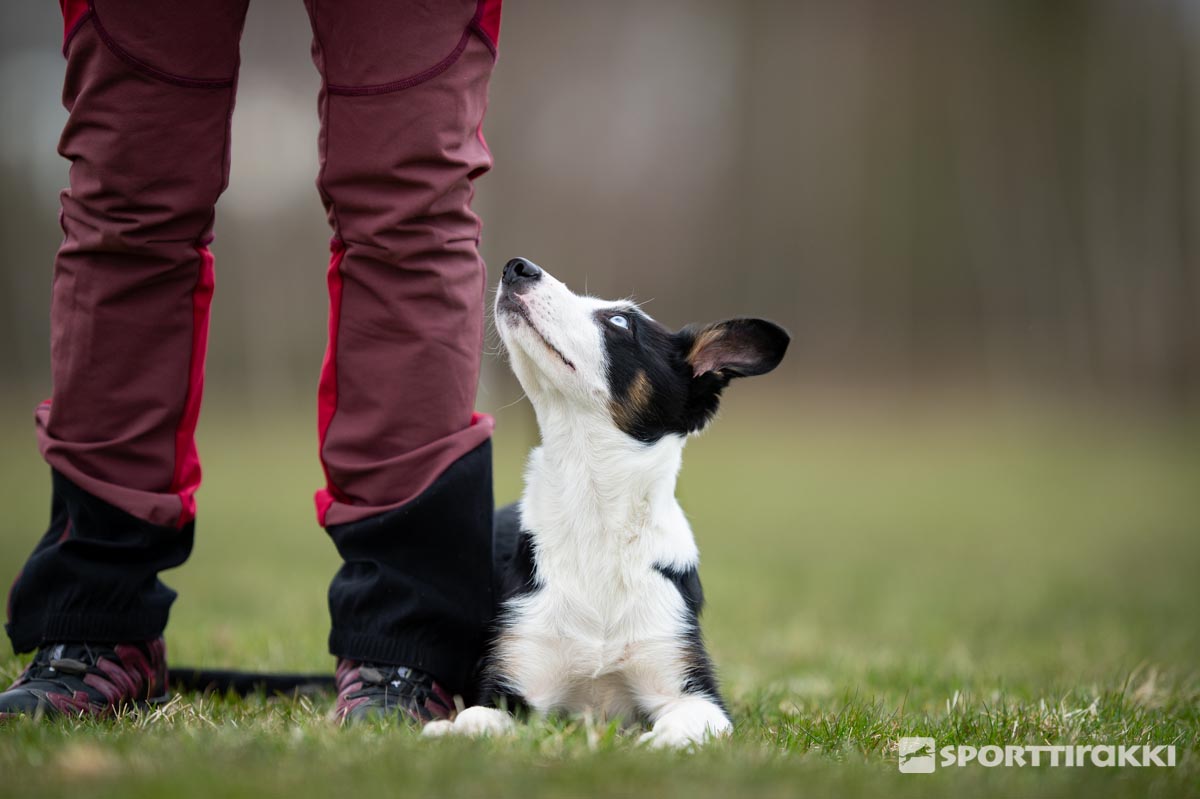
15 Jan The higher the energy level — the more calming skills a dog needs
Original author Piia Collan, 1 February 2022
Dog breeds have been developed for a wide variety of tasks, and different working roles require different traits from a dog. As a result, every dog has a certain energy level that is influenced by both breed and individual genetics. A dog’s original purpose — or, in the case of mixed-breed dogs, the background breeds — largely defines its natural tendencies, capabilities and limitations.
Breed-typical traits may include activity level and need for stimulation, guarding instincts, and prey drive. Of course, individual differences always exist, but regardless of the breed or mix, it is important to understand a dog’s original purpose and characteristics. This knowledge helps owners make better choices that support the dog’s well-being.
Everything starts with learning to calm down
Some people genuinely enjoy highly energetic dogs. However, when it comes to a dog’s overall well-being, every dog must be taught how to calm down. The higher the dog’s natural energy level, the more training should focus on calmness and recovery skills.
An energetic dog’s “engine” can always be turned back on later when needed. Calmness, on the other hand, is not something dogs magically develop on their own — it must be actively taught and practiced.
Sometimes behavior caused by elevated stress levels is mistaken for high drive or strong working motivation. If a dog cannot recover from training or activities, is constantly over-aroused on the field and restless in everyday life, a responsible owner will reconsider the activity. A person’s personal preferences should never come before a dog’s well-being.
Not all dogs are suited for all activities. A dog’s hobbies and training should always support its physical and mental health as a whole.

It’s easy to assume that a dog should automatically know how to stay calm and relaxed in various places and situations — even without being taught. But that expectation is unfair without training.
Living with humans means learning to wait
Because dogs live in a human-centered society, they must learn skills that allow them to live happily and safely alongside us. Often without realizing it, people place dogs in situations that require patience and self-control — situations that are completely normal to us.
Waiting for a bus, stopping during a walk to take a photo, or passing by something interesting without investigating it are all everyday examples. Humans may assume that dogs should automatically know how to behave calmly in these situations. Sometimes dogs are even expected to do so independently, without any guidance or training.
People often take it for granted that dogs will somehow magically remain calm and composed in a wide variety of environments and situations — even if these skills have never been properly taught.
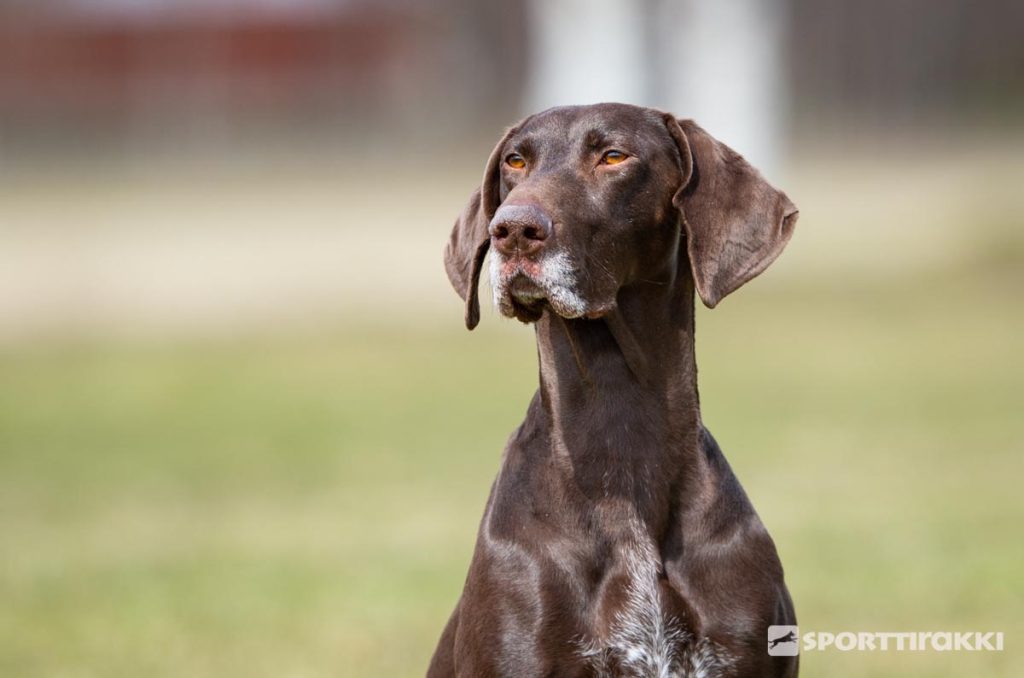
Most dogs begin to show mature calm behavior around three years of age, but this varies by breed and individual temperament.
Avoid over-arousal and chronic stress
A dog that is constantly running at full speed can be extremely challenging in daily life. It may react strongly to distractions, be restless and impulsive, and struggle to settle. Continuous stress significantly reduces a dog’s quality of life.
In the worst cases, a dog’s stress levels never truly come down. Living, training and even spending time together can become difficult or impossible. A chronically stressed dog may also struggle to read other dogs’ signals and can become socially withdrawn or reactive.
After an intense competition performance or a stressful encounter, stress levels remain elevated for a long time. If new stress hormones are released before the previous ones have dissipated, the dog can enter a severe stress cycle. Stress hormone levels take several days to decrease — and for dogs that have been stressed for long periods, recovery takes even longer.
Importantly, stress caused by positive excitement affects the body in the same way. Long-term, continuous stress can also lead to serious physical health issues.
Ball obsession drives energy through the roof
When an owner throws a ball, two of the most stress-inducing parts of a dog’s prey sequence are activated: chasing the prey and the kill bite. In play, these actions may be repeated dozens of times in a row.
“Ball obsession” is therefore a problem humans create. Many dogs will chase a ball or frisbee hundreds of times if given the opportunity. In the worst cases, the dog cannot focus on anything else and constantly demands the game.
Some dogs will stare at the owner’s pocket for the entire walk, ignoring their surroundings and even forgetting to relieve themselves. A common issue is leaving a dog at home that has supposedly been “tired out” with ball play — only to find it still restless, chewing door frames or furniture when left alone.
Of course, not all dogs become overstimulated by throwing games. A skilled trainer can use them as a powerful reward for the right individual. However, after any high-arousal play session, it is important to actively lower the dog’s energy level — for example, by scattering treats for the dog to sniff and search for.
Sniffing activates the dog’s sense of smell, and both sniffing and eating have a calming effect, helping the dog settle down.
Record what your dog does
Keeping a record of a dog’s daily activities can provide a realistic picture of how the dog actually spends its time and how it is coping. Does the dog get enough time to recover? Does it sleep too much — or too little? Does it get enough relaxed sniffing time on morning walks?
Activities should be timed and written down for at least two weeks to gather sufficient data. It is equally important to pay attention to the quality of activities and walks. Walks should primarily be the dog’s own time — full of sniffing and exploration — and part of every walk should be done at the dog’s natural pace.
It’s also useful to consider whether activities are for the human or for the dog. What does the dog actually do, and how much? Is there ten minutes of focused trick training every day at home, or two weekly one-hour sessions at a training hall where the dog is actively working for only fifteen minutes?
When you also record the dog’s behavior and emotional state during training and free time, you gain valuable insight into how the dog is truly feeling.
Puppies and adolescents need extra support
Puppies can be wild at times, and evening zoomies are completely normal. There is no need to worry about that. However, puppies should not be constantly entertained or given structured activities. They should also not be unnecessarily interrupted when playing or exploring on their own.
During sleep, puppies process what they have learned and their brains develop. Especially in families with children, it is essential to teach that a sleeping puppy is never to be woken or disturbed. The puppy should be left completely alone to rest.
Adolescence brings hormonal changes that often cause regression. Concentration, impulse control and previously learned skills may temporarily weaken. In some dogs, adolescence can be very intense, making it feel as though all training has disappeared.
This phase can be challenging for both dogs and humans — especially when it comes to developing patience and self-control.
When can you relax?
A dog’s upbringing and training are largely done during the first two to three years of life. After that, things usually become easier. Typically, by around three years of age, a dog is fully mature and has learned behaviors that support everyday life.
There are exceptions, of course, and different breeds mature at very different rates. Basic puppy training alone is never enough — it must be reinforced all the way into adulthood.
Calmness, patience and waiting skills should be actively trained throughout a dog’s early years. This is how lasting results are achieved and how balanced adult dogs are created — dogs that seem to “magically” know how to wait calmly and settle down anywhere, at any time.
Author Piia Collan
Piia Collan is a professional dog trainer based in Vääksy, Finland, working with dogs and their people at every stage of life. She helps build strong everyday skills, balanced training routines and a deeper cooperation between dogs and handlers — from puppies to adult and senior dogs. Piia’s approach is tailored to each dog and family, grounded in modern, dog-friendly training methods that support both learning and overall well-being. Her services are available locally, across Finland and internationally through online training and lectures. She offers private coaching, home visits, phone consultations, live online seminars and training courses. In addition, Piia provides exclusive in-home dog care, where dogs become part of her daily life during their stay. She also works closely with breeders and canine organizations, supporting responsible training and lifelong dog welfare.
No Comments